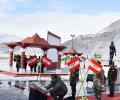
The Chinese authorities have been rapidly building defence infrastructure along the Line of Actual Control, indicating that they are preparing for a long period of tension with India, points out Jayadeva Ranade, the former senior RA&W officer and China expert.

Experts said the direction is meant to maintain party unity.

"Government is aware that China is developing infrastructure in border regions opposite India in the Tibet and Xinjiang autonomous regions," Minister of State for External Affairs Preneet Kaur told Rajya Sabha.

Days after a Pentagon report said Beijing built a large village in a disputed territory in the Arunachal Pradesh sector, India on Thursday said it has neither accepted any illegal occupation of its territory by China nor has it accepted unjustified Chinese claims.

Admitting that it was aware of China developing rail links in its border areas, including Tibet and Xinjiang Autonomous Regions, India said on Wednesday it keeps a 'constant watch' on all developments having a bearing on its security.

China's parliament on Thursday adopted the 14th Five-Year Plan, the mega blueprint containing billions of dollars worth of projects, including the controversial hydropower project on the Brahmaputra river in Tibet close to the Arunachal Pradesh border over which India has raised concerns.

Xi has called on Chinese border troops to enhance their capabilities in border defence and control to forge a "great wall of steel" along the country's borders, it said.
US President Barack Obama has proposed a $7.4 million allocation in his annual budget for preservation of the tradition and culture of Tibet in the Tibetan Autonomous Region and other parts of China.

He claimed China has a policy of keeping "hot spots like Taiwan, South China Sea and Tawang burning" in order to divert attention to its own failings.

China on Friday said that any successor to the present Dalai Lama should be approved by it, ruling out recognition to any heir nominated by him or by his followers.
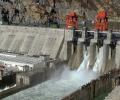
The over 3,800-km-long Brahmaputra, one of the longest rivers in the world passes through China, India and Bangladesh and has several tributaries and sub-tributaries.
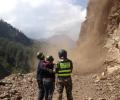
Over a dozen aftershocks jolted Nepal on Wednesday, keeping people on edge a day after a powerful 7.3-magnitude earthquake killed 76 people in the Himalayan nation that had just begun to rebuild itself following the devastation from the temblor less than three weeks ago.

'Its aim is to force the Bhutanese government to cede territory that China wants elsewhere in Bhutan to give Beijing a military advantage in its struggle with New Delhi.'

'Islamic State has declared that the liberation of Islamic Xinjiang from China is an objective. Beijing may well find that Pakistan is unable to assist in any meaningful way,' says China expert Jayadeva Ranade.
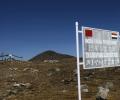
India on Thursday strongly rejected China renaming 15 places in Arunachal Pradesh and asserted that the state has 'always been' and will 'always be' an integral part of India and that assigning 'invented' names does not alter this fact.

Important for Chinese President Xi Jinping will be Zhao's discussions on the issues of Tibet and the Dalai Lama and his assessment of the likely results of India's coming national elections, notes former senior RA&W officer and China expert Jayadeva Ranade.

China's deteriorating economy is a serious concern. Xi Jinping and China's new premier will have a difficult task ahead of them after the 20th party congress, notes Jayadeva Ranade, the retired senior RA&W officer and China expert.

The Dalai Lama is 84 years old now and the issue of his successor has gained prominence in the last couple of years in the wake of his health issues.

The former Chief of Army Staff said India faces the most complex threats and challenges spanning a full spectrum of possible conflict -- from nuclear to sub-conventional -- but asserted that the armed forces are ready to deal with them.

'Why assail the Tibetan leader at a time when many in China realise that the Buddhist monk is the best bet if Beijing is seriously trying to find a solution to the Tibetan issue?' asks Claude Arpi.

All that India must aim for is to match China's military prowess adjusted to equal Beijing's India-specific military capability, argues Vivek Gumaste.

Nearly two decades ago, then defence minister George Fernandes said: 'China has built roads up to the border, while there has been negligence on India's part.' Since Fernandes uttered these brave words, what has been done on the Indian side? The Modi Sarkar is apparently trying, but little has been achieved so far, says Claude Arpi.

China has been taking "incremental and tactical actions" to press its claims at the Line of Actual Control (LAC) with India and has unsuccessfully sought to prevent New Delhi from deepening its relationship with the US during and subsequent to the standoff, the Pentagon has said in a major report on China's military modernisation.

'Intrusions by PLA troops in the Ladakh sector are more in number than elsewhere and this region is now likely to remain an area of enhanced Chinese interest,' warns China expert Jayadeva Ranade.

China said that it had put off the visit of Indian pilgrims who enter Tibet via the Nathu La pass "for safety reasons" in view of the border issue.
China is spending billions of dollars to improve infrastructure in Tibet and other parts of its border with India. Claude Arpi explains why New Delhi can't afford to ignore Beijing's plans.

How does blatantly claiming Indian territory help to maintain 'peace in border regions', is a mystery that only China can explain, notes Claude Arpi.

Chief of defence staff Bipin Rawat on Thursday said the controversy about the Chinese coming into the Indian territory and building a new village is 'not true,' and that the villages were well within the Chinese side of the Line of Actual Control.

Situated at a height of 15,200 feet above sea level, the pass sits on the top of a craggily formed Himalayan range that separates the Tibetan plateau from the Indian sub-continent.

Important for India was Xi's meeting with representatives of PLA officers and soldiers stationed in Tibet. The video of the encounter was interesting to watch, especially the large number of lieutenant generals and major generals, observes Claude Arpi.

The Standing Committee on Water Resources has recommended renegotiating the Indus Water Treaty with Pakistan to address the impact of climate change on water availability in the river basin and other challenges which are not covered under the agreement.
After the Ladakh fiasco where Xi Jinping did not expect the Indian Army to resist his land-grabbing tactics, he has to save face before his colleagues in the Communist party.' To bring the threat of a mega-dam to the northern Indian border is a clever move, observes Claude Arpi.

China has been keeping tabs on the restive Tibet province through a 'grid' system and some 600 'convenience police posts' armed with high-tech equipment that monitor the daily life of the citizens of Lhasa and other Tibetan towns. Worse, 'volunteer security groups' known as 'Red Armband Patrols' are roaming around in order to get more information and 'classify' each and every citizen, says Claude Arpi

'The need of the hour is to build on the positives and control the negatives,' says Colonel (Dr) Anil A Athale (retd).

The competition for the worst or most perilous 10 years has always been between the 1960s and the 1980s, points out Shekhar Gupta.

Tawang is very much a part of India, and if the present Dalai Lama decides one day to take rebirth in Tawang, the Indian government will openly welcome him and support him, notes Claude Arpi.

'The missile mounted near Kailash-Mansarovar is called DF-21. It is a medium-range, 2,200 kilometres ballistic missile. Its advantage is that it can cover all cities of north India, including New Delhi'

The Royal Observatory Greenwich has announced the shortlisted images of the 2022 Astronomy Photographer of the Year!

Communist China has recently developed a great expertise in 'soul reincarnation', feels Claude Arpi

The MEA asserted that Arunachal Pradesh was territorially intergal and inalienable to India.
